After installing a Viking dishwasher, use the exact code to choose the first checks. A fill error directs attention to the water supply and inlet route; a drain error calls for the hose, disposer connection, high loop and filters. Internal sensor, motor and communication messages require technical assessment. Keep the dishwasher installed and start with the accessible checks for the displayed condition.
2-2: confirm the incoming water route
2-2 is a fill error. The pressure sensor fails to reach its target during filling, while other model designs use temperature change or fill timeout to identify the condition. Begin by confirming that water is turned on to the dishwasher.
Inspect the accessible fill line for kinks. Check whether the installation has restricted supply or whether water pressure has decreased. For VDB200, the technical route checks pressure, inlet hose and water-valve restrictions. Arrange installer help when those connections cannot be reached safely.
A defective inlet valve is another possibility in the 325/450 technical table. Let a technician assess that component if the supply and accessible hose checks leave the fill concern unresolved. Leave valve wiring and the lower electrical enclosure closed during household preparation.
1-5: check the drain connection and routing
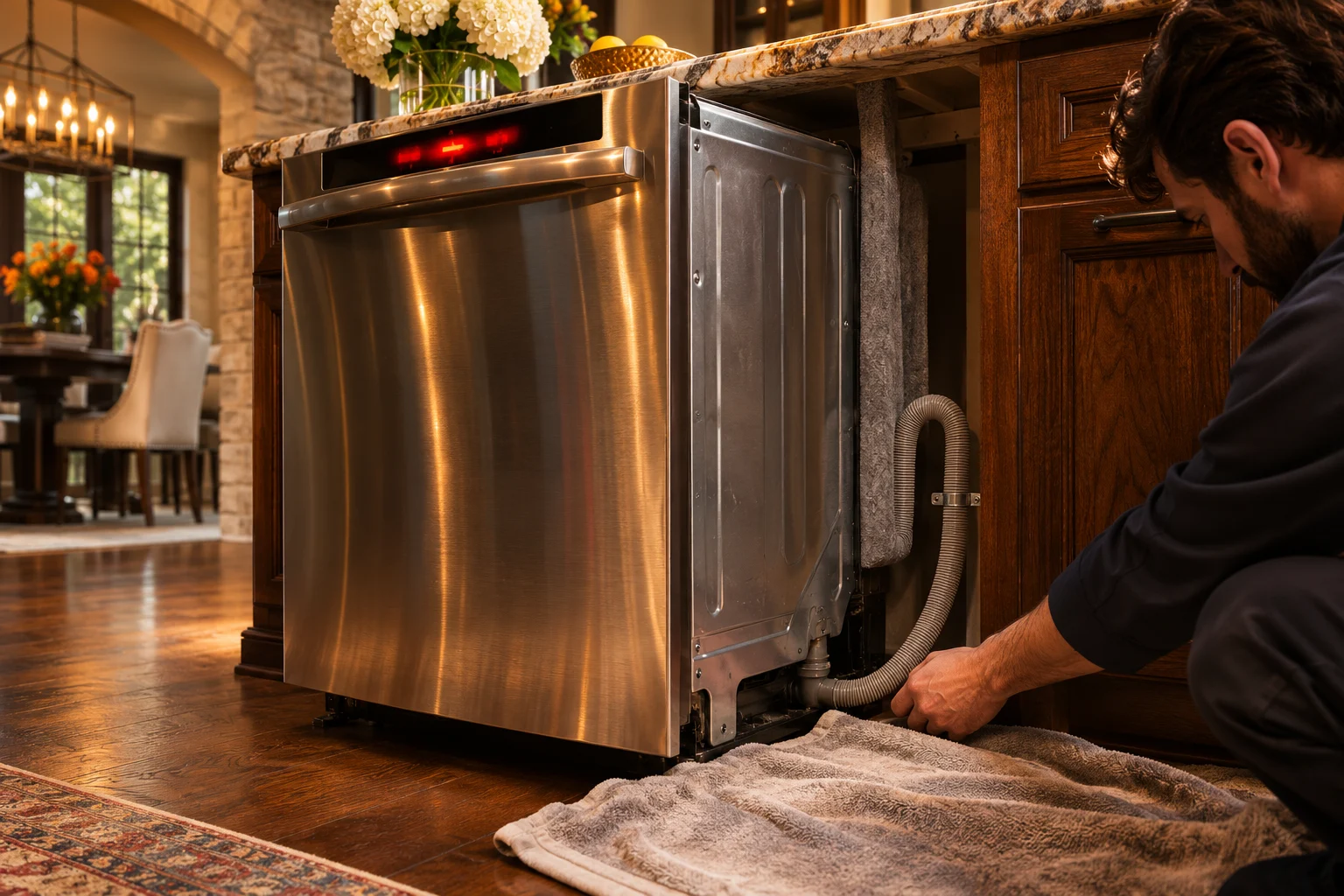
1-5 means water remains after draining. On pressure-sensor models, the empty threshold was not reached; on other models, retained water is detected by a different method. Check the accessible drain hose for blockage or kinks.
If connected to a disposer, make sure the knockout plug has been removed. Verify the hose high loop using the installation guide. Also check that the dishwasher is level front to back and side to side, with installation adjustments handled safely by the installer when access is difficult.
Check the filters for buildup using the owner manual. Disconnect power before cleaning, handle sharp debris cautiously and refit the components correctly. If the code remains after accessible drain and filter checks, arrange assessment of the continuing condition.
| Code | Meaning | First route |
|---|---|---|
| 2-2 | Fill target not reached | Check water turned on, supply pressure and inlet routing. |
| 1-5 | Water remains after drain | Check hose, disposer connection, high loop and filters. |
| 2-3 | Water below low-level threshold | Check secured rack items and proper drain high loop. |
| 1-1 | Moisture sensor reading out of range | Arrange base-sensor and connection assessment. |
| 1-3 | Main and motor controls cannot communicate | Arrange internal wiring and control assessment. |
Low water and siphon-related messages
2-3 means water in the sump is below the low-level threshold. Check that items are secured in the rack and that the drain has the required high loop. Use the installation guide for the route, with the installer addressing changes that require moving the machine.
2-5 concerns an abnormal pressure change, described as draining or filling too quickly. 4-5 identifies a fill level reached too quickly. 2-4 means the pressure sensor reports a high water level. Give the complete characters to service so the water-level condition can be assessed using the model’s detection system.
Sensor and motor messages belong with technical checks
1-1 concerns an out-of-range moisture sensor in the base pan. Its technical checks begin with connections to that sensor and its electrical condition. Keep the base covered and seek help if water or wet electrical access is present.
2-1 identifies a low, out-of-range pressure-sensor reading. The pressure sensor mounts at the sump retainer ring; technical assessment includes connection, sensor and harness condition. Leave those internal checks for the visit.
1-2 concerns motor operation or current outside its expected range. The technical procedure checks connections between the motor and its control. VDB200 uses a single-speed capacitor-assisted motor and has its own wiring, rotor and winding checks. 1-3 concerns communication between the main and motor controls, beginning with their connecting wiring.
1-4 identifies a diverter that failed to report the required position. The diverter directs wash water toward the upper or lower arm. Its technical checks involve wiring and position feedback. Keep the assembly enclosed and provide the code when requesting diagnosis.
Know the installed model’s normal functions
VDWU524 uses variable-pressure washing that adjusts water volume, pressure and temperature to the load and soil. Three wash arms work with triple filtration, and the upper rack has three height positions. Its installed exterior panel is stainless steel.
FDWU724 includes OpenAir drying, which opens the door automatically at cycle end. A blue light projects onto the floor during a cycle, while Turbo Fan Dry circulates drying air. CornerClean changes the lower arm’s axis to direct jets toward the corners.
DFUD042 requires 120 V AC, 60 Hz and a maximum 15 A draw. Its inlet-water pressure range is 18–176 psi. Delay Start postpones operation for five hours, and program choices include Normal, Heavy, Quick and Rinse/Hold. Check the selected program or delay when start time is the question.
Prepare one concise installer or service list
- Complete model and serial identification.
- The installation or move and first affected cycle.
- Exact code and visible fill or drain concern.
- Supply, high-loop, disposer and filter checks completed.
- Leakage, electrical concerns or access restrictions.
Viking dishwasher help in Dallas
Arrange Viking dishwasher repair in Dallas–Fort Worth through the contact form for a continuing installation-related fault. Stop use for smoke, sparks or unsafe leakage. Diagnosis and a written estimate precede repair with your approval.
Questions
What can I check for 2-2?
Confirm water is turned on and check accessible inlet routing for kinks or restrictions. Arrange pressure or valve assessment if filling remains unresolved.
What can I check for 1-5?
Check the drain hose, disposer knockout, installation high loop, level and filters. Use safe access and the model manual.
What does 1-3 mean?
The main control cannot communicate with the motor control. Internal wiring and control assessment belong with a technician.
Can FDWU724 open its door at cycle end?
Yes. OpenAir drying automatically opens the door after a cycle, and Turbo Fan Dry circulates air.