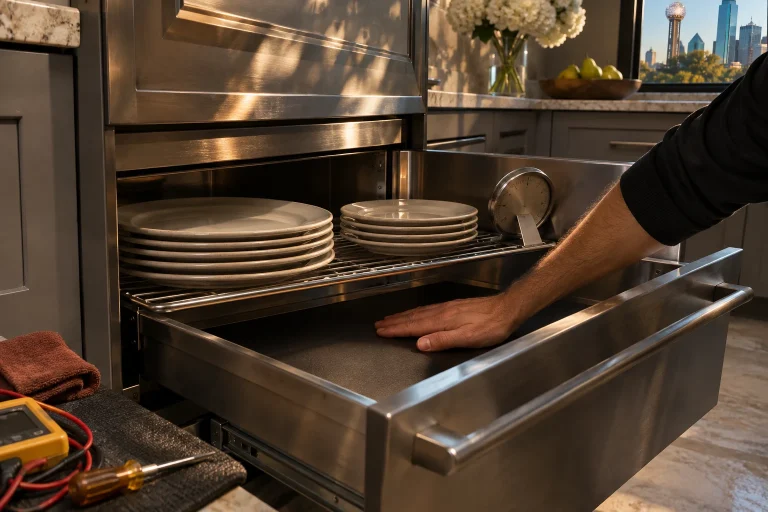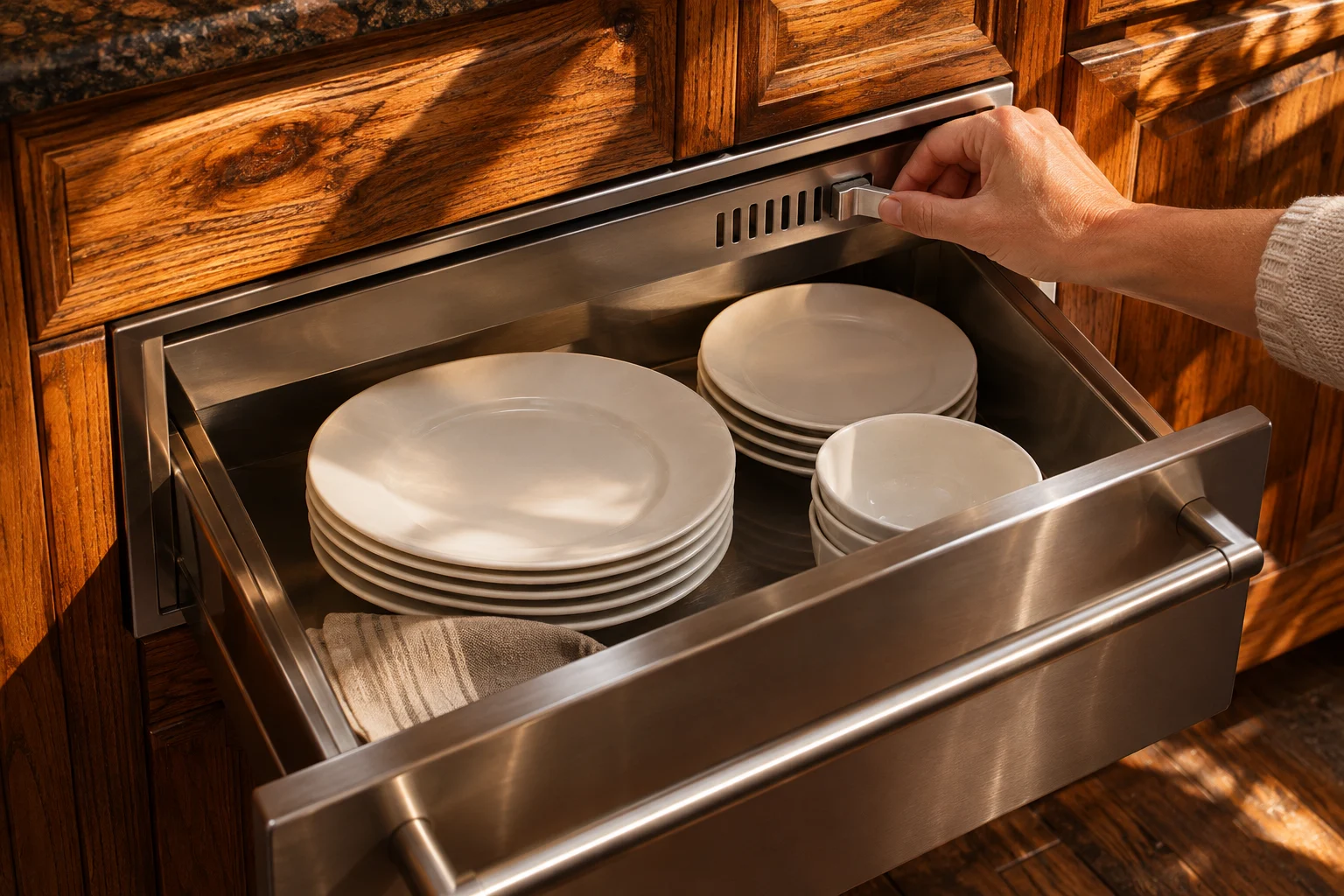
Viking warming drawer humidity vents help control whether held food stays moist or retains a crisper surface. A moist setting keeps more steam around the food, while a crisp setting allows more moisture to leave. Start by matching the setting and container covers to the food texture you want. If food is soggy, dry, or unevenly warm, check loading and control position before assuming the heater has failed.
Humidity and heat solve different problems
Heat keeps prepared food warm, while moisture control affects how that food changes during holding. Steam trapped around a crisp coating can soften it. Food held with too much moisture escaping can dry at the edges. Temperature selection and humidity therefore need to work together.
A moisture setting is not a direct food-temperature measurement. A drawer that feels humid can still have a heating or loading problem. Follow appropriate food-safety practices for the food being held and use the appliance only for its intended purpose. Avoid relying on texture or steam alone to decide whether food has been kept safely.
The owner manual explains the available settings and intended uses for the drawer. Check that description when deciding whether an accessory, container, or holding method is suitable. A warming feature should not be treated as an unspecified cooking or reheating method.
Use crisp for moisture that needs to escape
A crisper finish depends on preventing steam from collecting against the surface. Choose the appropriate moisture setting and use the container arrangement described for that food and drawer. A tightly covered dish can trap steam even when the drawer is set to release moisture.
Give steam a route away from the food without creating an unstable load. Avoid stacking hot containers so a lid is partly open and likely to slip. Use racks and pans supplied or approved for the appliance. The loading arrangement matters as much as the control position.
If a food loses crispness quickly, consider how much steam it releases and whether a cover is retaining it. Changing the humidity setting alone may have little effect when the container remains sealed. Compare a suitable arrangement on the next use instead of turning heat higher automatically.
Use moist for food prone to drying
A moist setting helps retain steam around held food. Suitable covers can also reduce surface drying. Keep lids seated securely and account for condensation when removing them. Hot droplets can collect on the underside and run toward hands or nearby surfaces.
The Viking VQEWD5301 includes removable steam pans, lids, and steam racks, with moist and crisp settings. Use those accessories by the appliance procedure. The VQEWD5421 also offers those moisture choices and has a concealed heating element.
Accessory names alone do not establish a water quantity or setup. Follow the described method before adding water or using a steam arrangement. Liquid poured into the wrong location can damage the drawer or reach electrical parts.
| Result you see | What to consider | Useful adjustment |
|---|---|---|
| Crisp food becomes soft | Steam retained by setting or lid | Use the intended crisp arrangement |
| Food dries at exposed edges | Moisture escaping too freely | Check moist setting and suitable covers |
| Uneven warmth | Loading, container mass, or heating condition | Spread the load as instructed and assess persistence |
| Control is hard to move | Residue or mechanism damage | Clean accessible deposits when cool |
| Moisture appears outside the drawer | Spill, condensation, or closure issue | Check safe visible areas and stop for electrical exposure |
Keep vents and movement clear
Foil, cookware, or loose material can obstruct a moisture opening or interfere with the drawer closing. Keep the designed openings clear. Avoid lining surfaces or covering vents unless the appliance instructions expressly allow that arrangement.
A drawer that cannot close normally loses its intended holding environment. Remove protruding cookware and check that pans and racks sit securely. Leave a bent slide, damaged retainer, or continuing closure problem for service.
Clean accessible grease and residue with the drawer off, cool, and power disconnected. Use the surface-care method for the finish and removable accessories. Keep cleaner out of control gaps and electrical openings, and dry components as directed before refitting.
Make a setting change easy to evaluate
- Choose the intended food-holding purpose.
- Select the heat and moisture options described for that use.
- Arrange suitable pans and lids without blocking openings.
- Check closure and safe food temperature during holding.
- Change the container or humidity arrangement when texture needs improvement.
A heavy cold container absorbs heat and changes the initial result. Use the preparation described for the drawer instead of comparing different starting conditions. Keep unnecessary door openings brief so heat and moisture remain controlled.
When the problem is more than a setting
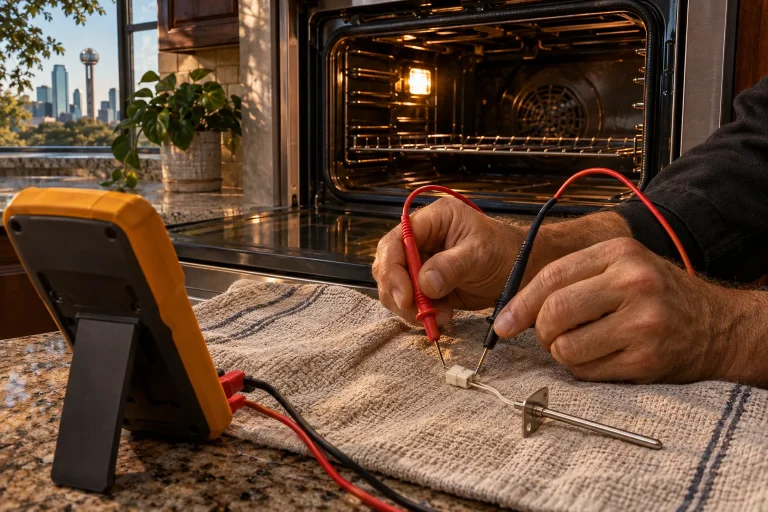
If the drawer remains cold, overheats, or responds unpredictably to controls, arrange diagnosis. A sensor, heater, switching component, or wiring problem can require testing. A concealed element should stay covered; removing the drawer liner to inspect it is technician work.
Smoke, sparks, burning odor, repeated breaker trips, or water near electrical connections means stop use. Leave an unsafe connection undisturbed and have the supply made safe. Never bypass a protective device to continue holding food.
The model hub and error-code hub provide further navigation when collecting appliance details. A code or indicator should be interpreted with the actual drawer model and symptoms.
Viking warming drawer service in Dallas
Keep one record: model, selected heat and moisture settings, food and container arrangement, texture or heating problem, closure behavior, and checks completed. Use Viking warming drawer repair or contact in Dallas–Fort Worth. Describe whether the concern is moisture, heat, or control movement so service can focus on the right system.
Questions
What is the purpose of a crisp setting?
It allows more moisture to escape so held food is less likely to soften from trapped steam. Use the setting instructions for the drawer.
What does a moist setting change?
It retains more moisture around the food to limit drying. Covers and containers also affect the result.
Can I use a warming drawer to cook raw food?
Use it only for the purposes described by the appliance instructions. Keep food safety separate from the preferred moisture texture.
What if the moisture control will not move?
Let the drawer cool and check for accessible residue without forcing the mechanism. A jammed or damaged control needs assessment.