Leave Viking service diagnostic modes to a technician. You can help more safely by preserving the ordinary fault message, identifying the appliance and explaining what happened before it stopped. A test result only becomes useful when it is matched to the right model, interpreted correctly and connected to the actual symptom.
Knowing a button sequence is not the same as knowing what a test establishes. An unfamiliar service instruction may describe an internal measurement or a correction that requires access to electrical components. Do not turn that instruction into a household experiment. A clear account of the fault is a better starting point than an unexplained service display.
What a code can tell you
Consider range F01. It describes a door-lock position that does not suit the selected operation. The required position differs between cooking and cleaning. The control can cancel the current operation and turn off the elements. That meaning helps explain why the range stopped, but it does not make forcing the door or bypassing the lock appropriate.
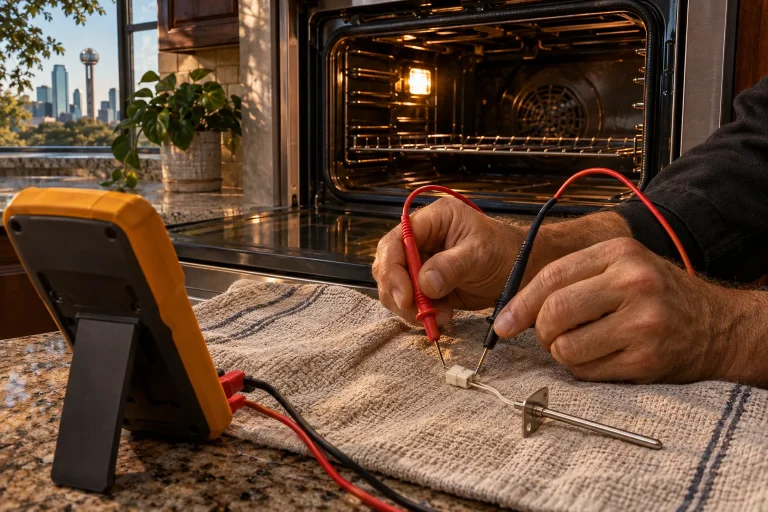
The same distinction applies to range F02. This identifies an open or shorted oven temperature sensor condition. Cooking and cleaning are canceled, and the control becomes inoperable. Internal sensor access is a service task. The owner can instead report whether the message appeared during an attempted cooking cycle or during cleaning.
For range F03, the control is not receiving the expected cooling-fan feedback signal. Baking or cleaning is canceled. The useful observation is the interrupted function and the complete light pattern, not a guessed fan replacement. Similar interruptions can arise from different monitored conditions, which is why the exact message matters.
Observation and intervention are different jobs
| Situation | Useful owner record | Leave to the technician |
|---|---|---|
| Range door fault | Selected function and visible message | Door-lock diagnosis and correction |
| Temperature sensor message | When cooking or cleaning stopped | Internal sensor and connection work |
| Induction indicator flashes | Count, grouping and pause pattern | Internal power-device investigation |
| Wall oven control error | Full code and whether it returned | Touch-pad testing and control diagnosis |
Writing down what is visible does not require a cabinet panel to be removed. Keep a distinction between an observation, such as a repeating flash group, and a conclusion, such as a failed electronic part. The first can be reported directly. The second requires evidence that an owner normally cannot obtain from the display alone.
Why the appliance family cannot be skipped
Induction indicators illustrate how specific the interpretation can be. A single flash with a short interval concerns internal power-device overtemperature. A group of two flashes indicates an internal power-device malfunction, while three flashes concerns that device’s temperature sensor. Those meanings belong to the induction indication system. They should not be applied to a range cycle light merely because a similar number of flashes was observed.
Wall oven codes need the same care. F21 concerns a key detected as shorted for an extended period and cancels a timed cycle or delayed start. F1 concerns the electronic range control. Neither abbreviation should be transferred casually to a different control system. Record the equipment type along with the letters and digits so the account does not lose its context.
Safe information to collect yourself
- Copy the complete model from the appliance identification label.
- Describe the ordinary operation selected before the interruption.
- Photograph the message or record the visible light sequence.
- Note whether the fault appeared once or returned during later normal use.
- Include the household checks already completed, keeping service commands for the technician.
- Keep covers, safety switches and internal connections undisturbed.
Use the matching owner manual for routine operating guidance. If its instruction does not apply clearly to the model or message, pause rather than substituting a sequence found for another appliance. Do not keep selecting an interrupted operation simply to produce a more detailed error. An account can be useful even when the appliance is left switched off.
Stop where internal access begins
Disconnect electrical power before ordinary cleaning. Smoke or sparks mean you should stop using the equipment. If you smell gas, leave and contact the gas utility. Do not bypass a protective device to continue cooking or to make a service test proceed. These limits remain relevant even when a display explanation sounds straightforward.
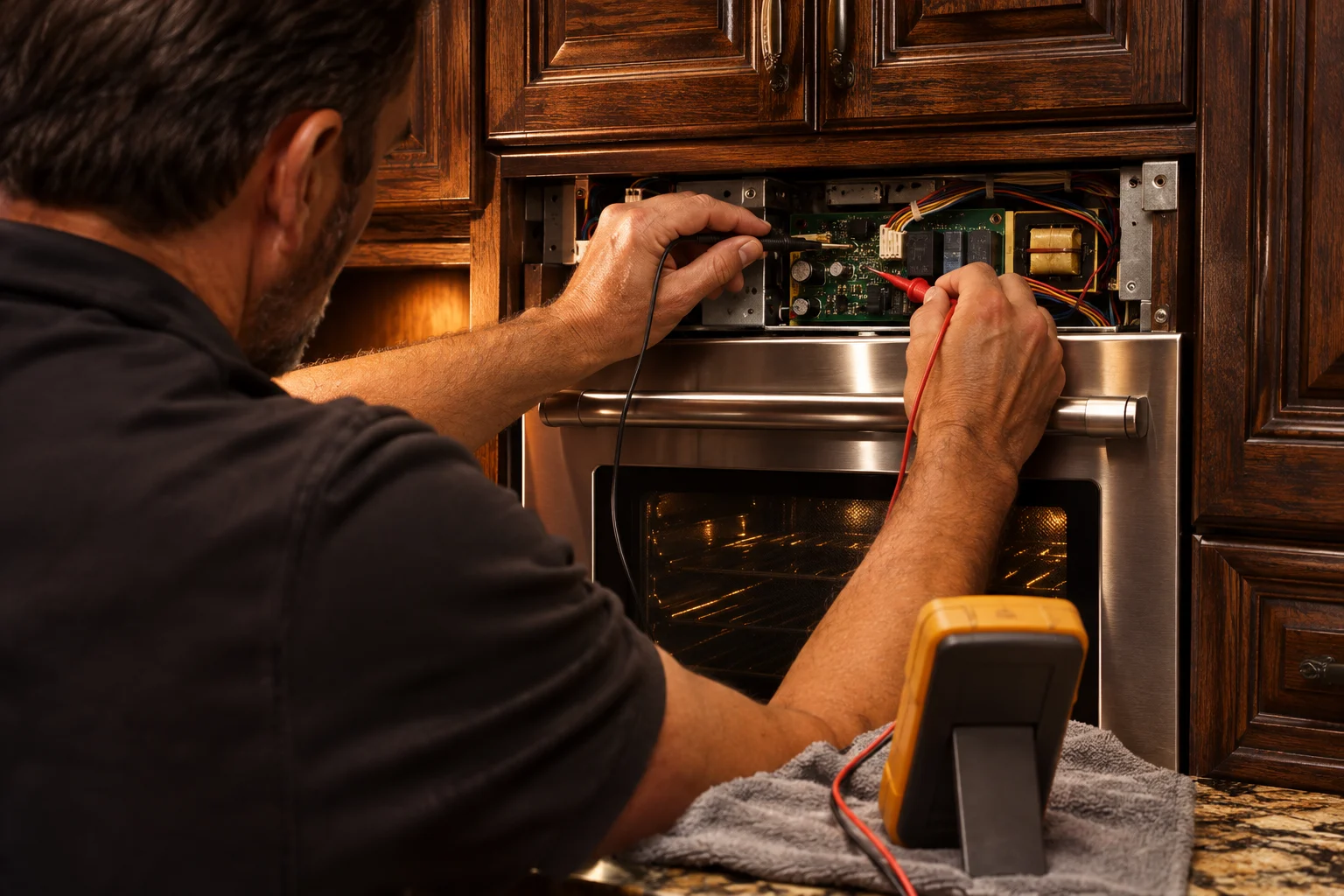
A repair instruction about replacing a sensor, correcting a fan issue or testing a touch pad describes work beyond recording a symptom. Reaching the named component and deciding what is wrong are not the same thing. Ask for diagnosis rather than opening the appliance to see whether a connection looks loose.
When describing an intermittent condition, separate remembered events from what you can still observe. Say that a light was flashing if the count is uncertain. An honest incomplete description gives the technician a clearer basis for questions than a confident code assembled from memory.
Bring the model context to the visit
A FDBB5364 refrigerator, for example, has separate fresh-food and freezer spaces, an automatic ice maker and soft-close humidity drawers. A report should identify which area is involved. That sort of equipment description is useful without supplying a diagnostic procedure or making an unsupported claim about a failed part.
For Dallas–Fort Worth service, send the model, exact message and operating history through Viking appliance service. Keep your original photograph or notes available for the visit. The aim is to give the technician a faithful record of what the appliance did while leaving testing and the repair decision tied to the actual equipment.
Questions
Should I enter a service mode to understand a fault?
Start with the normal display and the matching model information. Service testing should be handled by a technician who can interpret the result in context.
Does F02 prove that the control needs replacing?
No. Its documented condition concerns an open or shorted oven temperature sensor, so it does not establish a control replacement by itself.
Can a flash count be useful without a diagnostic menu?
Yes. Record the visible sequence, pauses and the appliance model without opening the equipment.
What should I do if an appliance sparks?
Stop using it. Internal investigation is not a safe owner task.