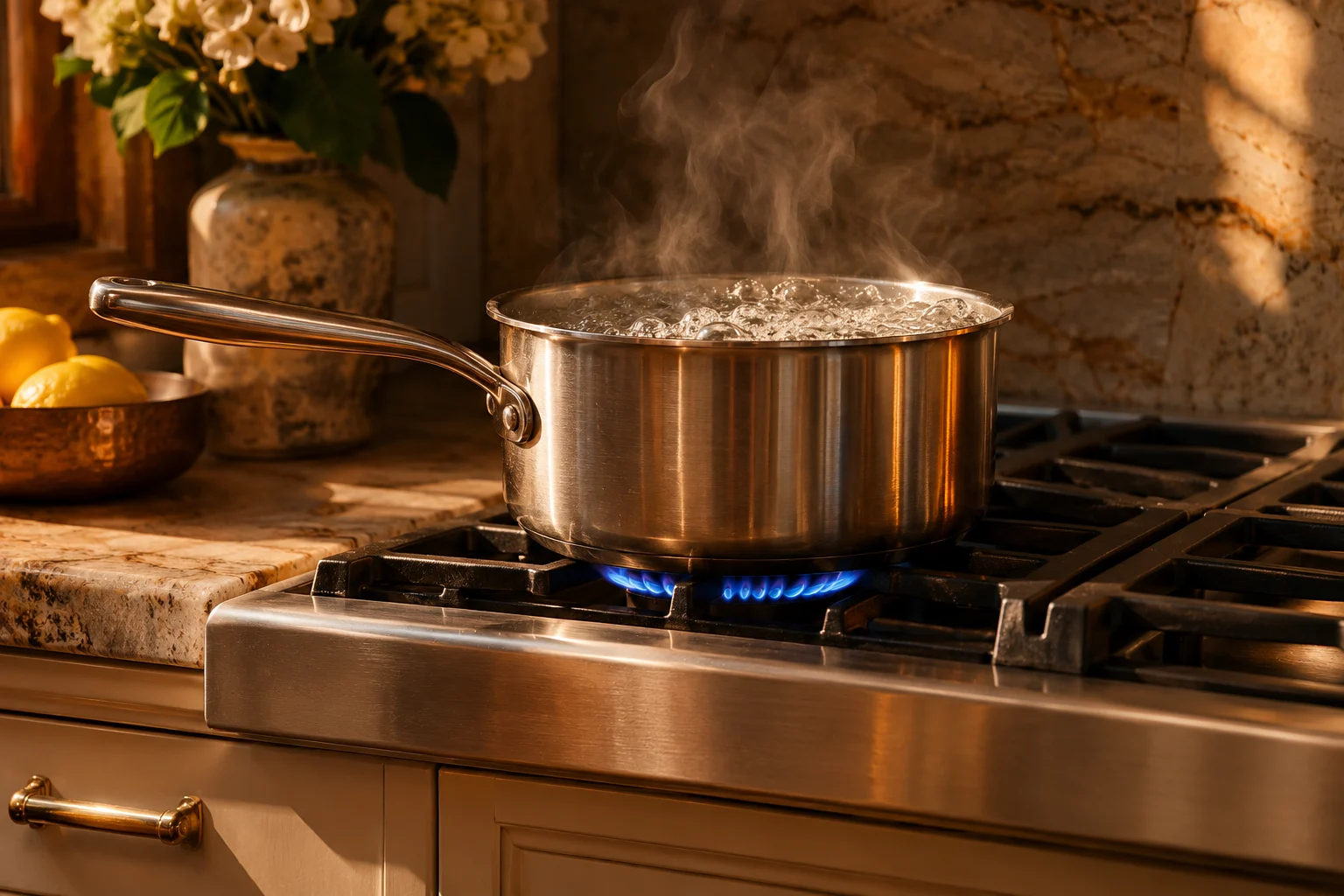
A Viking gas rangetop that boils food at its lowest setting may have the wrong burner or cookware for the task, a cap that is not seated correctly, or a gas-delivery adjustment that needs attention. Start by confirming the selected burner and its low setting with a suitable pan. Leave valve calibration, supply pressure checks, and orifice changes to a technician.
Start with the setting and the food
Simmering means gentle, sustained cooking with limited bubbling. A small amount of sauce in a light pan responds quickly to heat, so it can boil even when a larger load would simmer. Check the amount and consistency of the food as well as the knob position.
Use a cooking vessel suited to the burner and task. A heavy, stable base can spread heat more evenly than a thin pan, while an oversized or tiny base changes the way heat reaches the contents. Center the pan securely on the grate and keep the handle in a safe position.
Read the low or simmer portion of the control marking rather than assuming the last visible knob position is correct. Some burner designs have different control behavior across their range. Use the owner manual for the actual rangetop before changing the way the knob is operated.
Inspect the cool burner assembly
A burner cap that was moved during cleaning can sit unevenly. That can distort the flame pattern or interfere with reliable ignition. Turn the control off, let the parts cool, and check that removable caps and heads are fitted in their intended positions.
Clear loose food around accessible burner ports using the permitted care procedure. Keep parts dry before refitting them. Avoid mixing similar-looking caps between burner positions; a part that nearly fits can still change flame distribution.
If the cap rocks, the flame is uneven, or the burner repeatedly goes out, stop and arrange inspection. Keep the gas ports and internal metering parts intact. Enlarging an opening or bending a component as a quick fix can alter fuel delivery.
| Low-heat symptom | What to consider | Useful owner check |
|---|---|---|
| Small sauce portion boils rapidly | Load and cookware respond quickly to heat | Use an appropriate vessel and selected burner |
| Flame pattern changed after cleaning | Cap or head seating | Refit cool removable parts using care directions |
| Flame barely changes with the knob | Valve or control problem | Stop use of that burner and request diagnosis |
| All burners seem stronger after installation | Supply or fuel setup | Ask the installer to assess the gas arrangement |
| Flame goes out at low setting | Assembly, supply, or calibration issue | Turn the burner off and arrange service |
The valve controls the gas reaching the burner
The burner valve meters gas as its control is turned. Its low-end operation must be suitable for the burner and fuel arrangement. Wear, damage, or an incorrect adjustment can leave too much gas flowing at the intended low setting.
A technician can compare the response across settings and check the valve using the appliance’s service procedure. A knob that slips, binds, or no longer follows its markings may also need inspection. Keep the range off if you cannot reliably turn a burner off.
Low-flame adjustment is model-specific. Turning a hidden screw by a remembered amount can make a flame unstable or create an unsafe operating condition. Leave the control panel closed and ask for the valve and supply to be assessed together.
The orifice must match the installation
A gas orifice is a precisely sized opening that limits fuel flow into the burner system. Its required configuration depends on the appliance and fuel setup. An incorrect or altered orifice can affect the flame across the operating range, including simmer.
If the complaint began after installation or fuel-related work, explain that history to the technician. The professional inspection can check the setup, supply regulation, and correct components. Keep the orifice unchanged and avoid inserting drills, wires, or needles into it.
A supply-pressure problem can affect more than one burner. Compare the overall pattern only through normal operation that is safe; stop when flames or ignition are abnormal. Pressure testing, regulator work, and leak checks require the proper equipment and procedure.
Use the right appliance information
The VGRT362 is a rangetop with its own installation and operating details. The RVGC3301 gas cooktop has sealed burners and SureSpark automatic reignition. Those configurations need their own parts and procedures even though both use gas.
Electric and induction surfaces regulate heat differently. The MVIC6301 induction model has a simmer setting, while the RVEC330 uses radiant elements. Their control and diagnostic information belongs to those electrical systems, not a gas valve.
For gas simmer trouble, focus the request on the actual flame, selected burner, and cookware. A technician can then assess fuel delivery without confusing it with an induction power-control complaint.
When to stop cooking
If gas is smelled, leave the area and contact the gas utility. Stop using a burner that fails to shut off, repeatedly loses its flame, or shows abnormal combustion. Keep nearby combustible items away and allow hot parts to cool before any care.
Owner checks are limited to normal setting selection, suitable cookware, and the cool removable burner assembly. Leave internal valves, regulators, orifices, wiring, and safety components to a technician. Avoid improvised heat diffusers unless Viking permits the accessory for that appliance.
- Confirm the burner and the intended low setting.
- Use a stable pan suited to the cooking task.
- Check cool cap seating after cleaning.
- Stop for gas odor or unreliable flame control.
- Request professional fuel-system assessment when low heat remains excessive.
Prepare the model, affected burner, behavior at low and higher settings, cookware, and recent installation or cleaning in one brief account.
Viking rangetop repair in Dallas
For persistent excessive simmer heat in Dallas–Fort Worth, request Viking cooktop and rangetop repair. Explain whether one burner or the entire surface is affected so the technician can assess the setting, assembly, valve, and fuel configuration.
Questions
Can I enlarge or clean a gas orifice with a needle?
Leave the orifice unchanged. Altering its opening can change gas flow and requires professional correction.
How does RVGC3301 handle an extinguished flame?
It has SureSpark electronic ignition and automatic reignition. A burner that repeatedly goes out or behaves abnormally still needs assessment.
Do induction flash codes describe a gas simmer valve?
Induction and gas appliances use different heating systems. Use product information that belongs to the identified rangetop.