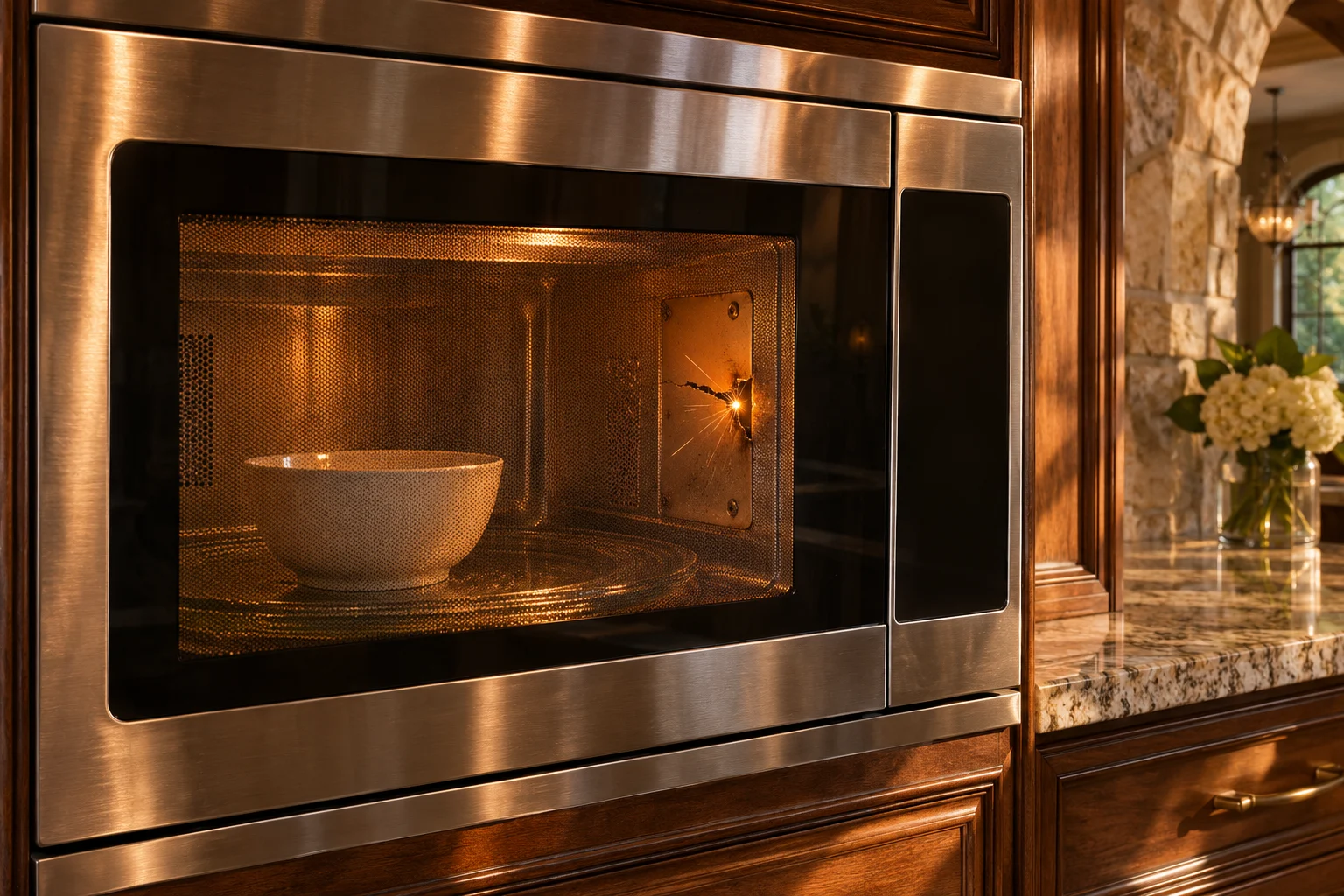
Stop a Viking microwave immediately if sparks appear inside. Common causes include unsuitable metal, foil edges, food burned onto the cavity, or a damaged waveguide cover. Let the interior cool before checking accessible surfaces, and keep the appliance off if there is a burned cover, exposed damage, or any uncertainty about the source.
Stop use before looking for the source
Cancel cooking and keep clear of the hot contents. If there is smoke or a fire inside, keep the door closed and disconnect power only when that can be done safely; use the appropriate fire response if the situation continues. Opening the door during a cavity fire can add air.
Once the situation is safe and the cavity is cool, remove the food and cookware. Inspect with a light without touching hot residue or sharp damaged surfaces. Keep all fixed covers and door parts attached during this owner inspection.
A brief spark still deserves attention. Repeating the cycle to see whether it happens again can burn the cover or damage a cavity surface further. Find and address the visible cause before considering any return to cooking, and arrange service for damage or an unexplained event.
Metal can concentrate the microwave field
A fork, twist tie, metallic decoration, or projecting foil edge can create arcing. Some microwave cooking directions permit specific accessories or limited foil use, but those arrangements depend on the appliance and mode. Use only the materials and placement expressly permitted by Viking for the operation being performed.
Check the container as well as loose objects. A decorative rim can contain metal even when the dish otherwise looks like glass or ceramic. Packaging may have hidden metallic layers. Remove unsuitable cookware from use in microwave mode and choose a known microwave-safe alternative.
Keep permitted accessories positioned as directed and away from contact with cavity walls. A rack or support intended for another mode can become a problem when used incorrectly. The operating instructions define the safe accessory arrangement.
| Possible source | What a cool inspection may reveal | Response |
|---|---|---|
| Loose metal or foil | A utensil, tie, rim, or projecting foil edge | Remove unsuitable materials and check for resulting damage |
| Food residue | A dark burned deposit on an accessible surface | Clean with the permitted method after cooling |
| Waveguide cover damage | Scorching, a hole, looseness, or missing material | Keep the microwave off and request inspection |
| Cavity coating damage | Peeling, exposed metal, or a burned spot | Arrange assessment before further use |
| Door or seal damage | A bent area, loose latch, or damaged closing surface | Stop operation and obtain service |
The waveguide cover protects an opening
The waveguide cover is a protective cavity component over the path where microwave energy enters. It helps keep food and grease out of that opening. Its material and position depend on the design, so identify it through the owner manual instead of prying at a panel that looks removable.
Grease or food on the cover can overheat and carbonize. A burned area can then keep arcing. A cover that is cracked, perforated, loose, or badly scorched needs proper replacement and inspection of the area behind it.
Never run the microwave with that cover removed. Leaving the opening exposed can allow contamination and damage. Keep cleaning liquid out of its edges and openings; wipe only the accessible surface using the permitted method.
A technician can determine whether the cover alone is affected or the underlying area also needs attention. Choose replacement components by the full appliance identity, not by trimming an improvised piece to fit.
Clean residue without creating new damage
Food splashes can dry onto walls, the ceiling, or the rotating support. Once burned, the dark residue can contribute to further sparking. With power disconnected as directed and the cavity cool, soften and wipe accessible soil using a gentle approved cleaner and soft cloth.
Avoid steel wool, sharp scrapers, and aggressive abrasives that can damage the cavity coating. Remove permitted trays or supports only through their normal care procedure. Dry them and refit them correctly before use.
If a burned mark remains as a damaged surface after ordinary cleaning, request assessment. Covering it with tape, household paint, or foil introduces more uncertainty and can make the condition worse. A repairer needs to see the actual surface.
Turntable and load placement matter
The RVM320 has a turntable that supports the load during cooking. A dish that catches the walls or prevents normal movement can create poor heating conditions and bring unsuitable material into contact with the cavity. Keep the load within the intended space.
Use food and cookware prepared for the selected cooking mode. Running an empty cavity or repeatedly heating a dried-out load is unsuitable for testing. Check food directions and stop if the contents overheat or scorch.
Viking appliance arrangements differ. The VMOD241 has its own installed configuration, while RVM320 is identified as a conventional microwave oven. Use the full model identification when locating the operating and care information.
Owner checks have a clear boundary
- Stop cooking and allow safe cooling before inspection.
- Remove unsuitable loose metal and examine the cookware.
- Clean only accessible surfaces using the permitted care method.
- Keep fixed covers, door switches, and the outer enclosure intact.
- Arrange service for damage, repeated sparking, or an unknown source.
The high-voltage section can retain hazardous energy after disconnection. Keep the enclosure closed and leave internal testing to a technician. A damaged door or latch also requires repair before operation resumes.
Arrange Viking help in Dallas
Collect the model, location of the sparks, cookware used, visible residue or damage, and whether smoke appeared in one short account. Use Viking error information and the model hub if a display message accompanied the event.
For a Viking microwave in Dallas–Fort Worth, request microwave repair and describe the sparking before another cooking attempt. Keep the appliance off when its cover, cavity, or door needs assessment.
Questions
Can I remove the waveguide cover to keep cooking?
Keep the cover in place. A burned, loose, or damaged cover needs the correct inspection and replacement before further use.
Does a child lock make a damaged microwave safe to operate?
RVM320 includes a child safety lock to prevent unwanted operation. A damaged cavity or door still requires inspection before cooking resumes.
Should I remove the outer cover after unplugging?
Leave the enclosure closed. High-voltage components inside a microwave can remain hazardous after power is removed.