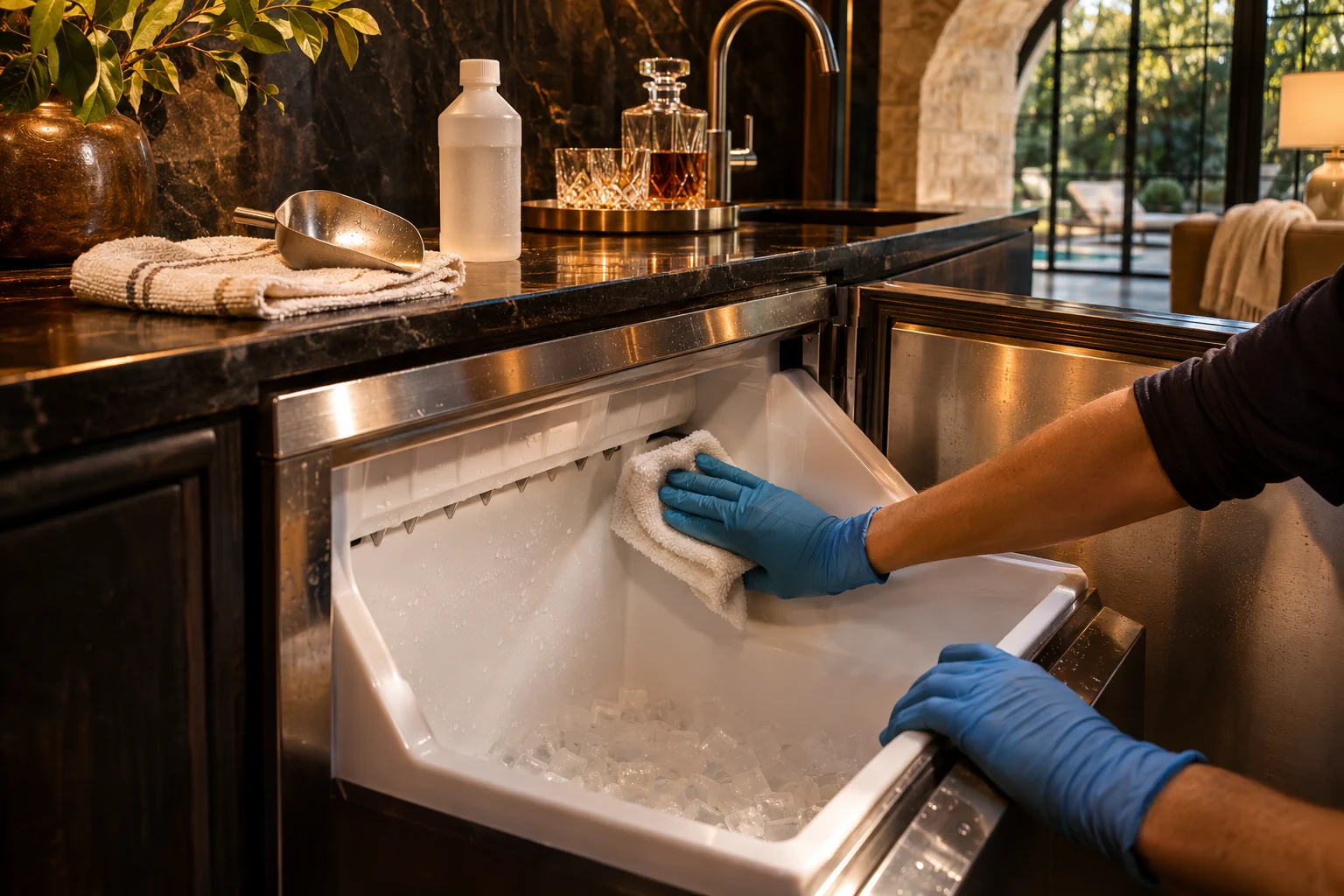
A Viking ice machine needs mineral cleaning and food-contact sanitizing to keep water paths clear and ice-storage surfaces clean. Start with the cleaning reminder, visible deposits, and changes in ice quality, then prepare the machine for its own care cycle. Remove ice as directed, use the approved cleaner and sanitizer in their prescribed stages, and finish every rinse. Persistent low production, leakage, or poor drainage needs assessment beyond routine cleaning.
Why deposits change the result
Water carries dissolved minerals into the ice-making system. As freezing and water movement continue, deposits can collect on cold surfaces and inside water paths. Buildup may interfere with ice formation or release, and it can leave visible film. A machine that still makes ice can therefore be ready for cleaning.
Food-contact surfaces have a different concern. The bin, scoop, and reachable storage areas need hygienic care so ice stays suitable for use. Grease from nearby cooking, dust, and handling can add soil. Keep the scoop clean and avoid storing unrelated items inside the ice compartment.
Cleaning removes deposits and soil; sanitizing follows with a product and method intended for the surface. Sanitizer applied over heavy residue cannot substitute for removing that residue. Complete both tasks as the care procedure requires, keeping their products and stages distinct.
Use reminders with actual condition
The Viking FGIM5151 has a Time to Clean alert in its LED controls. The FPIM5151 includes both Check Water and Time to Clean indicators. Read the active indicator so a water-supply concern is not handled only by resetting a cleaning reminder.
The cleaning schedule and control sequence are in the owner manual for the machine. Water quality and usage affect how quickly deposits return. If scale appears frequently, have water conditions assessed instead of increasing chemical strength or repeatedly shortening cycles by guesswork.
Inspect accessible surfaces between reminders. A change in ice appearance, reduced output, a persistent odor, or a dirty bin deserves attention. Identify whether the issue concerns mineral buildup, storage cleanliness, incoming water, or drainage before choosing the next task.
Prepare the appliance before the cycle
- Identify the machine and obtain its care procedure.
- Gather the approved cleaner, sanitizer, and suitable protective items specified by their labels.
- Remove stored ice and prepare the bin as directed.
- Check that the drain route is operating normally.
- Set up the machine for its prescribed cleaning stages.
Keep hands away from moving ice-making parts. Disconnect power before manual removal or cleaning of parts when the procedure calls for it. A powered cleaning cycle needs its own setup, so follow the sequence instead of combining manual access with active operation.
Protect nearby surfaces from spills and keep chemicals away from food and stored ice. Use the specified dilution and placement. An unapproved cleaner can attack metal, plastic, seals, or coatings. Mixing chemicals can create hazardous fumes or leave unsuitable residue.
Mineral cleaning and sanitizing have different targets
| Task | What it addresses | Completion check |
|---|---|---|
| Mineral cleaning | Scale on ice-forming and water-contact surfaces | Complete the prescribed cleaning and rinse stages |
| Manual soil removal | Reachable deposits in permitted storage parts | Clean surfaces without damaging their finish |
| Sanitizing | Hygienic treatment of approved food-contact areas | Use the correct product and contact method |
| Drain inspection | Water leaving the machine during care | Confirm no backup or escaping water |
Allow any attached ice to release by the prescribed method. Sharp tools and force can damage the forming surface, liner, or mechanism. Keep an assembly that will not release normally for service rather than trying to pry it loose.
Rinse removable parts as directed and refit them correctly. A misplaced water-distribution part or loose bin component can create a new problem when production resumes. Check orientation and normal seating before restoring operation.
Sanitize the scoop and storage area
Use the food-contact procedure for the scoop and accessible bin surfaces. Follow the sanitizer label for concentration, application, and any rinse requirement. Keep household cleaning products out of improvised combinations and away from ice intended for consumption.
Discard ice exposed to cleaning solution according to the care instructions. Complete the return-to-production procedure before using new ice. A reset of the reminder belongs after the maintenance is finished, so the indicator corresponds to work actually completed.
The Viking FCIU515D includes antimicrobial lighting. That feature accompanies the machine’s design; ordinary cleaning and sanitizing still need their prescribed routine. Use the care process for every food-contact area intended for owner access.
Drainage and airflow can limit recovery
Cleaning sends water through the system, so a restricted drain can cause backup. The FCIU515D has a factory-installed drain pump, while installation arrangements vary across ice machines. Inspect exposed tubing for obvious compression without disconnecting it or moving the appliance against its connections.
Keep designated ventilation openings clear. Dust and stored objects can restrict heat rejection and reduce production even after the water system is clean. Leave concealed pump access, internal fans, wiring, and refrigeration components to a technician.
Stop use for active leaking near electricity, smoke, sparks, a burning odor, or repeated breaker trips. Have an unsafe connection made safe before approaching it. A cleaning cycle is unsuitable for investigating those symptoms.
When cleaning is not enough
- Recurring mineral buildup calls for a water-quality assessment.
- Persistent drainage trouble needs the discharge path and pump checked.
- Failed ice release or harsh mechanical noise needs appliance diagnosis.
- Electrical or cooling faults require technical access and testing.
Keep one short service record: model, alert, cleaning products and stages completed, ice-quality change, water or drain symptoms, and unusual sound. The error-code hub can help organize a displayed message.
Viking ice-machine help in Dallas
Use Viking undercounter ice-machine repair or contact in Dallas–Fort Worth for problems that remain after proper care. Describe the cleaning outcome so service can focus on the water system, drain, forming mechanism, or cooling circuit.
Questions
Does a cleaning reminder replace inspecting the machine?
Inspect ice quality and accessible surfaces as well as responding to the reminder. Water conditions and use can affect how quickly deposits develop.
Are cleaning and sanitizing the same task?
Cleaning removes soil and mineral deposits. Sanitizing treats food-contact surfaces after cleaning using an approved product and procedure.
Can I mix cleaner and sanitizer together?
Keep products within their prescribed stages and avoid mixing chemicals. Follow the appliance procedure and product label.
What should I do when water backs up during cleaning?
Stop and have the drainage path assessed. A pump or concealed restriction needs service before another cycle adds more water.